
Quick answer: Aircon cleaning in Singapore costs about $40–$60 per unit for general servicing, $80–$150 for a chemical wash, and $150–$250 for a chemical overhaul. If the unit smells musty the problem is mould — Pico X Health mould hygiene servicing is a flat $90 per indoor unit with no trip or transport charge, using steam-assisted, water-only cleaning with no added chemicals, fragrances or coatings.
Based on: HVAC Mould Prevention Study Field Data Verification Pico X Health Case Studies
Aircon Cleaning in Singapore: What You're Actually Paying For
Four different things get sold as "aircon cleaning" here, at prices from $40 to $250 a unit. This guide explains what each one does inside the unit, what it costs, and how to tell which one your aircon needs — especially if the real problem is mould rather than dust. For mould on walls and ceilings, see mould removal Singapore.
Aircon mould servicing — $90/unit, no trip charge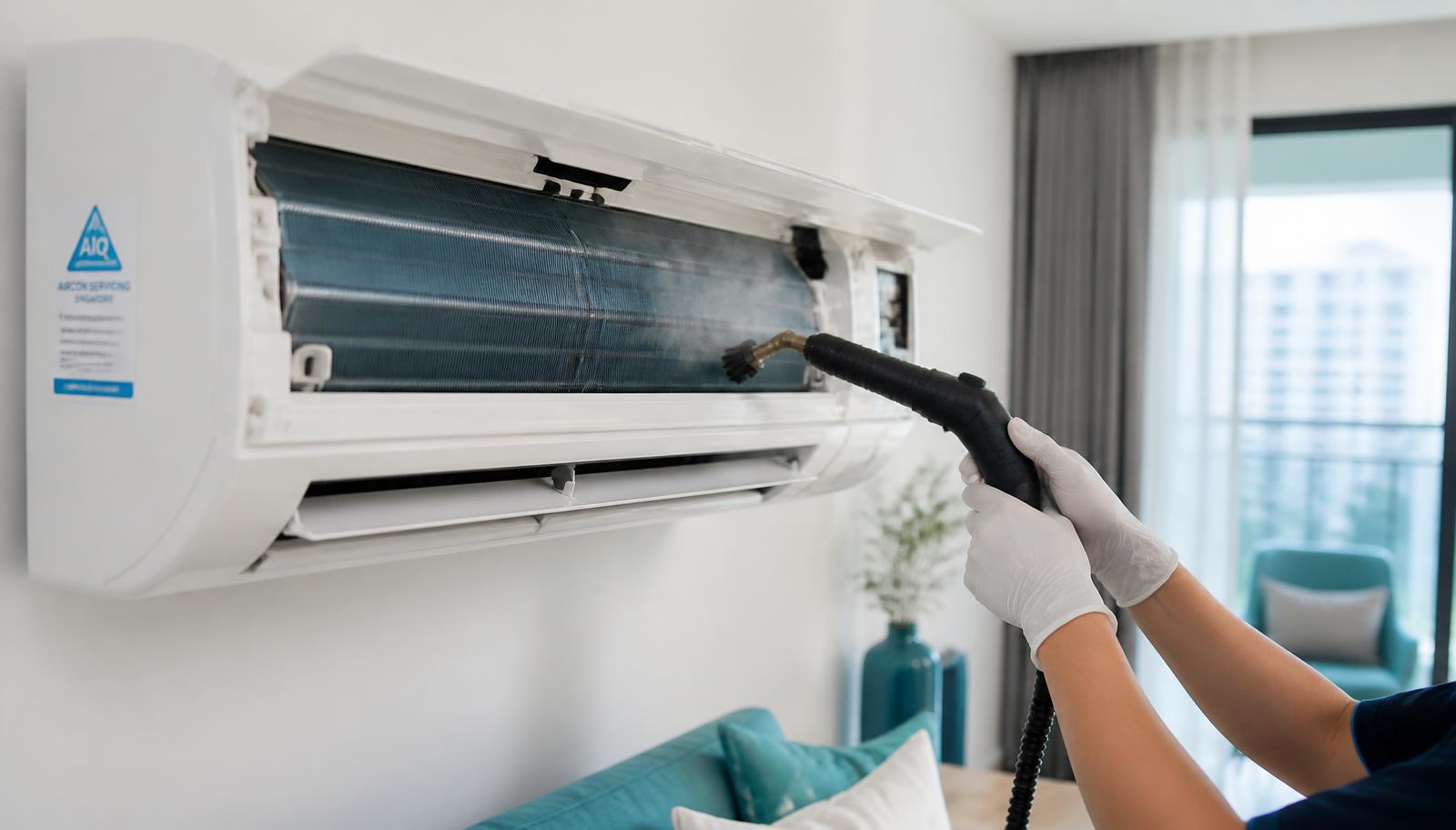
The four types of aircon cleaning
Prices are typical Singapore market rates per indoor unit, except the last row, which is ours.
| Service | Typical price | What happens | Right when | Limitation |
|---|---|---|---|---|
| General servicing | $40–$60 / unit | Front panel wipe, filter rinse, drainage check, quick vacuum of the visible grille. | Routine dust control on units that are already clean. | Barely touches the evaporator fins and blower wheel — where mould actually grows. A musty unit stays musty. |
| Chemical wash | $80–$150 / unit | Coil and blower sprayed with an acidic or alkaline chemical, flushed, fan-dried in place. | Heavy dust and grease loading, e.g. kitchen-adjacent units. | Aggressive chemistry can pit aluminium fins over repeated washes, leaves no residual protection, and biofilm regrows in weeks. |
| Chemical overhaul | $150–$250 / unit | Unit dismantled off the wall, blower and casing soaked and scrubbed, drainage line blown out. | Blocked drainage, water dripping from the unit, years of neglect. | Highest cost and downtime. Overkill for a unit whose only symptom is a musty smell. |
| Mould hygiene servicing (Pico X Health) | $90 / unit flat | Non-corrosive steam on fins and blower wheel, water-only rinse, drip pan and drain flushed, with no cleaning chemicals, fragrances or coatings added. | Musty smell, black streaks on fins, allergy or asthma in the household, mould on nearby walls and ceilings. | Not aircon repair — no gas top-up or compressor work. |
Price comparison at a glance
| Service | Price / indoor unit | Touches fins & blower | Residual protection | Fixes musty smell |
|---|---|---|---|---|
| General servicing | $40–$60 | No | None | No |
| Chemical wash | $80–$150 | Partly | None | Weeks only |
| Chemical overhaul | $150–$250 | Yes | None | Months |
| Mould hygiene servicing (Pico X Health) | $90 flat | Yes | None — water only | No coating left behind |
Market ranges are typical Singapore rates in 2026 and exclude gas top-up or repair. Pico X Health pricing is flat with no trip, transport or call-out charge — one unit or five, it's $90 each.
By brand: what we see in Singapore homes
- Daikin — tight fin spacing traps dust fast, so streaking shows early. The blower wheel is reachable without a full dismantle, so steam servicing usually restores it without an overhaul.
- Mitsubishi Electric / Starmex — deep drip pans hold residual water after shutdown. Drain-line flushing matters more than fin scrubbing on these units.
- Panasonic — wide louvres make surface mould visible early. Filters are easy to over-clean while the evaporator behind stays untouched.
- Midea / LG / Hitachi — common in newer BTOs on multi-split systems. Cheaper blower housings retain moisture longer, so 3-monthly hygiene servicing pays off.
We service all of the above plus cassette and ducted splits. We don't open the outdoor compressor — that's repair territory.
How often, by how you use it
| Usage pattern | Recommended interval |
|---|---|
| Living room, running most of the day | Every 3 months |
| Master bedroom, nightly 8+ hours | Every 3–4 months |
| Guest room, occasional use | Every 6 months |
| Household with asthma, eczema or infants | Every 3 months |
| Unit already smelling musty | Now — then 3-monthly |
Where the mould actually is
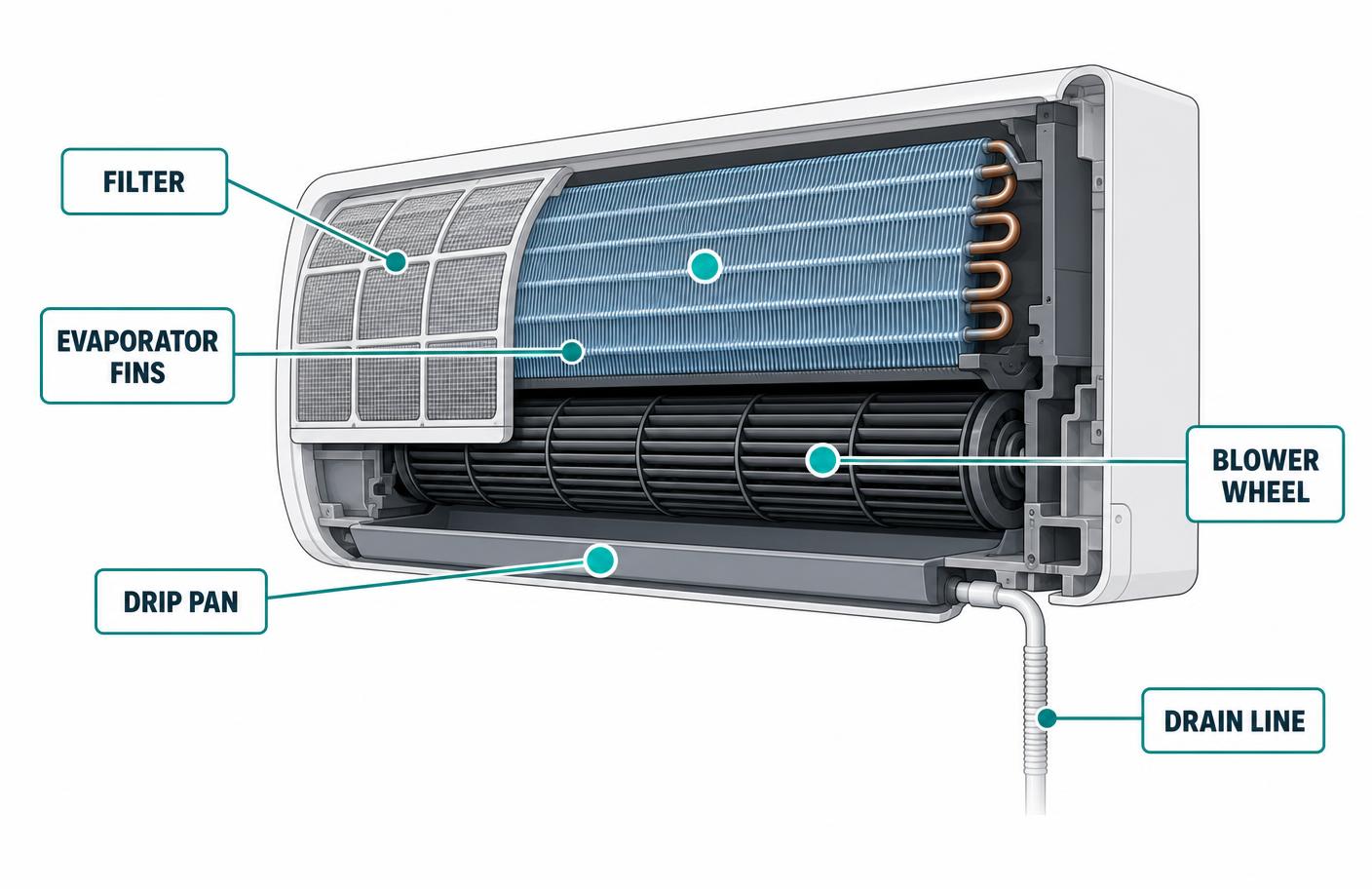
- Evaporator fins — cold and permanently damp while cooling. Dark streaks between fins are colonies, not dust.
- Blower wheel — moisture plus fine dust makes the perfect substrate, and it's what pushes spores into the room.
- Drip pan and drain line — standing water grows biofilm that re-seeds the whole unit every time the fan starts.
The front filter you rinse monthly is the least important of the four — which is why DIY filter cleaning never fixes a musty unit. Full anatomy in where mould hides inside an aircon.
How to tell what you need
- Weak airflow, dusty grille, no smell — general servicing is enough.
- Water dripping, gurgling, unit shutting off — drainage problem; chemical overhaul or an aircon technician.
- Musty smell on start-up, dark fin streaks, allergy flare-ups — mould. Steam-assisted, water-only cleaning, not an acid wash. See chemical-free servicing vs chemical wash.
- Mould on the ceiling or wall near the unit — treat both together, or the surfaces get re-seeded within months.
- Not cooling, ice on the pipe, gas smell — that's repair, not cleaning; we refer you to a licensed aircon vendor.
If it's mould: flat $90 per indoor unit, no trip or transport charge, chemical-free and water-only with no added fragrances or coatings. Book aircon mould servicing or WhatsApp us a photo.
Aircon cleaning FAQs
How much does aircon cleaning cost in Singapore?
General servicing runs about $40–$60 per indoor unit, chemical wash $80–$150, and a full chemical overhaul $150–$250. Pico X Health mould hygiene servicing is a flat $90 per indoor unit with no trip, transport or call-out charge — one unit or five, it's $90 each.
How often should aircon be cleaned in Singapore?
Every 3–4 months for daily-use units and every 6 months for night-only bedroom units. Once a year is too long here — biofilm starts forming on a wet evaporator within 4–6 weeks in 80–90% ambient humidity.
Do I need a chemical wash or just a normal clean?
If the unit is only dusty, general servicing is enough. If it smells musty, blows a damp odour on start-up, or you can see dark streaks between the fins, that's mould — and neither a general clean nor an acid wash gives you residual protection.
Is chemical aircon cleaning safe for children and pets?
Standard chemical washes use acidic or alkaline agents that need to be fully flushed and aired out. Pico X Health hygiene servicing avoids them: steam-assisted, water-only cleaning with no added cleaning chemicals, artificial fragrances or chemical coatings.
Why does my aircon still smell after a chemical wash?
Because the smell is MVOCs from live mould colonies on the blower wheel and inside the drip pan. A wash removes surface soil but leaves no residual barrier, so the biofilm re-establishes within weeks.
Can aircon mould cause mould on my walls and ceiling?
Yes — a mouldy unit aerosolises spores over the whole room every time it runs, and cold air on warm walls creates the condensation those spores need. Treat the aircon and the surfaces together or it comes back.
Do you charge a transport or call-out fee?
No. There is no trip, transport or call-out charge on any Pico X Health job — the quoted price is the price.