Home >
Research >
Inter-Flat Condensation Framework
Featured White PaperPolicy Framework
Managing Inter-Flat Condensation and Mould in HDB: A Multi-Party Resolution Framework
Evidence-based framework for resolving neighbour mould disputes in Singapore HDB flats. Based on 240 cases reported in 2025.
Pico X Health Research•January 2025•20 min read
Quick Answer
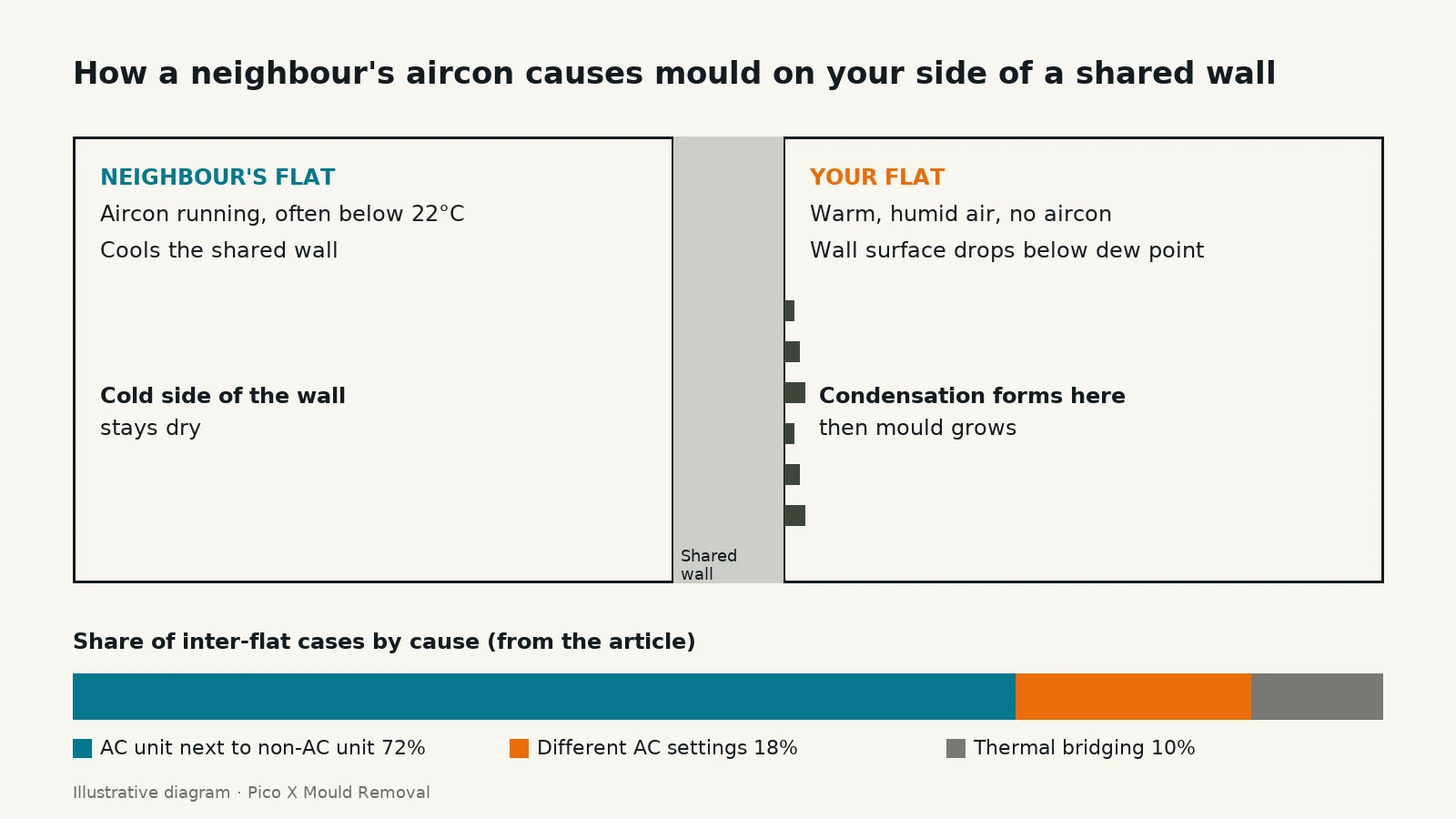
Based on 240 HDB cases reported in 2025, most 'neighbour mould' disputes are inter-flat condensation, not leakage: a neighbour's aircon chills a shared wall or slab and your side drops below dew point. The resolution framework is document, measure, mediate, mitigate — photograph and log the damp, capture surface-temperature and moisture data in a written report, raise it via HDB or the Community Mediation Centre, and apply thermal-break coating on your own side, which works even without the neighbour's cooperation.
Inter-flat condensation represents one of the most challenging mould issues in Singapore's HDB flats, often leading to prolonged disputes between neighbours. This white paper presents a structured resolution framework based on analysis of 240 reported cases, providing clear guidance for root cause identification, responsibility allocation, and sustainable remediation.
The Problem
Inter-flat condensation occurs when temperature differentials between adjacent units cause moisture to accumulate on shared surfaces. Common scenarios include:
Air-conditioned unit adjacent to non-air-conditioned unit (72% of cases)
Different AC temperature settings between neighbours (18% of cases)
Structural thermal bridging in older buildings (10% of cases)
Case Distribution (240 Cases, 2025)
Root Cause
Percentage
Avg. Resolution Time
AC temperature differential
72%
4.2 weeks
Structural issues
10%
12+ weeks
Water leakage (misdiagnosed)
8%
6.5 weeks
Ventilation inadequacy
6%
3.1 weeks
Other
4%
Variable
Resolution Framework
Phase 1: Diagnostic Assessment
Thermal imaging of shared walls
Humidity and temperature logging (72-hour minimum)
Moisture mapping of affected surfaces
Interview both parties regarding AC usage patterns
Phase 2: Root Cause Determination
Using thermal data and moisture mapping to identify:
Condensation patterns (typically follows wall temperature gradients)
Water ingress patterns (typically follows gravity/structural paths)
Ventilation deficiencies (moisture accumulation in specific zones)
Phase 3: Responsibility Allocation
Cause
Primary Responsibility
AC differential (cooling party)
Unit owner running AC below 22°C
Structural defect
HDB (if common area) or Town Council
Water leakage
Source unit owner
Ventilation
Affected unit owner (internal ventilation)
Phase 4: Remediation
Short-term: Mould removal and surface treatment
Medium-term: Insulation installation or AC adjustment
Long-term: Monitoring and maintenance protocols
Key Recommendations
Avoid AC settings below 22°C in units with shared walls
Consider thermal insulation panels for chronic cases
Establish communication channels with neighbours early
Document conditions with photos and humidity readings
Engage neutral third-party assessment when disputes arise