# Booklice in Singapore Homes: Why Mould Feeds Them & How to Get Rid of Them
You spot a tiny pale insect scurrying along a bathroom tile grout line. Then another. Then a whole cluster on the back wall of a wardrobe, or on the spine of an old book. In Singapore, the odds are overwhelming that you're looking at booklice — and their appearance is a message worth listening to.
Booklice (order Psocoptera, most commonly Liposcelis species) are almost universally misidentified in Singapore homes. They're called "tiny white bugs", "book mites", or lumped in with dust mites, silverfish or even termites. They are none of those. And getting the ID right matters, because booklice don't have a pest problem — they have a moisture and mould problem. Kill the bugs and leave the mould, and they will be back within weeks.
This guide covers what booklice actually are, why Singapore homes are their natural paradise, the exact do's and don'ts to get rid of them, and when the DIY route stops being enough.
What booklice actually are (and are not)
Booklice are 1–2 mm long, soft-bodied, translucent white to pale grey, wingless when found indoors. Under a magnifying glass they look a little like a miniature termite worker or a slender aphid. They move in short bursts. They do not bite humans or pets. They do not damage wood, furniture or clothes structurally. They do not spread disease.
What they do eat is microscopic mould, mildew and fungi — specifically the invisible film of mould spores and hyphae that grows on paper, cardboard, wallpaper paste, book bindings, drywall paper facing, grout, plaster, wardrobe backing boards, and shoe leather in high humidity. If you're seeing booklice, you have a mould food source somewhere on the surface they're crawling on. That food source is often too thin for the human eye to notice.
This is why booklice are best thought of as a biological humidity indicator, not a pest. They're the household equivalent of a canary in a coal mine — they show up before the mould problem is obvious enough for you to see it.
Booklice vs mould mites vs dust mites vs silverfish
The four "tiny white things" Singaporeans confuse the most:
| Pest | Size | Bites? | What they eat | What they signal |
|---|---|---|---|---|
| Booklice (Psocoptera) | 1–2 mm, visible moving | No | Surface mould, mildew, starches | High humidity + active surface mould |
| Mould mites (Tyrophagus) | 0.3–0.5 mm, look like moving "dust" | No | Mould directly | Heavier, wetter mould colony |
| Dust mites (Dermatophagoides) | 0.2–0.3 mm, invisible without microscope | No (allergen only) | Human/pet skin flakes | Bedding & upholstery, not mould |
| Silverfish | 10–15 mm, teardrop-shaped, silvery | No | Starches, paper, glue | Damp cupboards, but tolerate lower humidity than booklice |
If it's visible to the eye and moving on grout or paper — booklice. If it looks like dust that shimmers when the light hits it right — mould mites. For a deeper look at the closely related mite problem, see our [mould mites in Singapore guide](/mould-mites-singapore).
Why Singapore homes are booklice paradise
Booklice thrive at relative humidity (RH) above 60%, and reproduce fastest around 75–90% RH with temperatures of 25–30°C. Singapore's outdoor RH averages 82% year-round, spiking to 98%+ during monsoon squalls, and indoor RH in un-air-conditioned rooms tracks close to outdoor.
The classic booklice hotspots in Singapore homes:
- Bathrooms — grout lines, silicone edges, behind toilet tanks, under sinks
- Bomb shelters (household shelters) — steel doors sweat, no ventilation, cardboard storage
- Wardrobes and shoe cabinets — closed dark spaces, especially against external walls
- Kitchen cabinets — under-sink area, behind fridges, dish racks
- Aircon ledges and window sills — condensation zones
- Bookshelves and stored paper — old books, cardboard boxes, unused documents
- Under-mattress and headboard backing — especially against external walls
If you have booklice in more than one of these zones simultaneously, the underlying issue is house-wide humidity, not one leaky pipe.
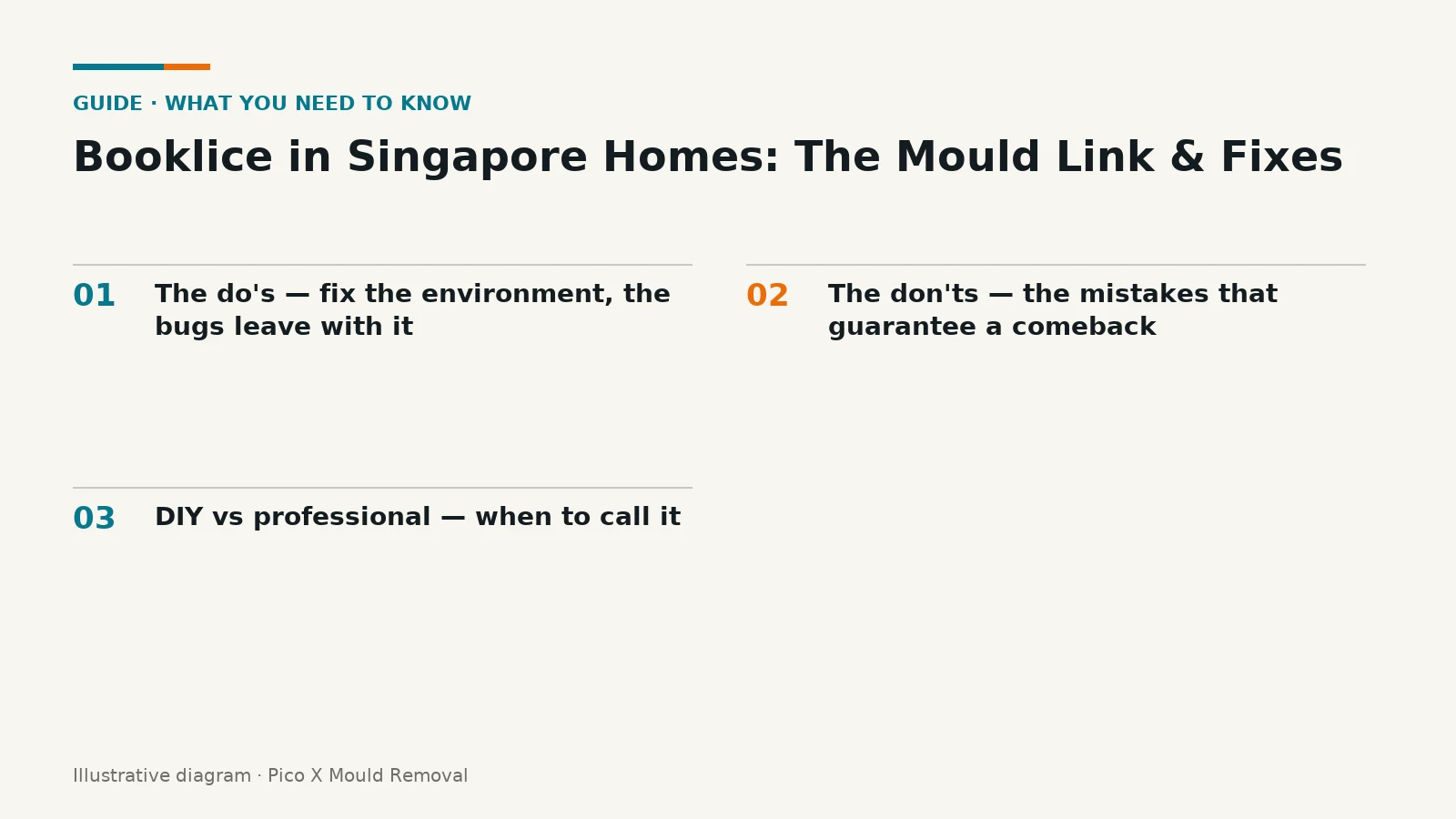
The do's — fix the environment, the bugs leave with it
1. Drop indoor humidity to 50–55% RH. This is the single most effective action. Booklice cannot reproduce, and their eggs desiccate, below 55% RH. Use a dehumidifier in enclosed spaces (bomb shelter, walk-in wardrobe, storage room) or run aircon "dry mode" for 2–3 hours in the evening. A cheap hygrometer (S$15–25) tells you where you actually are. 2. Find and fix the moisture source. Leaking bathroom silicone, sweating cold-water pipes, a slow toilet flush leak, condensation on aircon ledges, or an external wall that's been damp since the last monsoon. If you don't fix the source, humidity will keep climbing back. 3. Physically remove visible mould at source. Don't just wipe — the film they're feeding on is what needs to go. For grout and hard surfaces, a hydrogen peroxide 3% solution or a purpose-built mould remover, applied with a stiff brush, then wiped clean with a damp microfibre. For soft surfaces (drywall paper, backing boards), the material itself may need replacing. 4. Ventilate closed spaces. Open wardrobe doors daily for 30 minutes. Run bathroom exhaust fans for 20 minutes after every shower. Crack the bomb shelter door open when the outside air is dry (sunny afternoons after 2pm — see our [humidity habits guide](/top-humidity-habits-that-grow-mould-singapore)). 5. Dry, then discard or seal cardboard and old paper. Cardboard is a booklice buffet. Move stored cardboard boxes into airtight plastic bins with a silica gel or calcium chloride desiccant packet. Wipe down book spines and shelve them with airflow gaps. 6. HEPA-vacuum the affected zone. A HEPA vacuum removes the live insects, eggs, and — critically — the mould spores they're feeding on, without kicking them into the air. Regular vacuums spread spores.The don'ts — the mistakes that guarantee a comeback
1. Don't just spray insecticide. Household bug sprays kill the visible booklice for a few days. The mould food source is untouched. New booklice migrate in or hatch from unaffected eggs, and you're back to square one within 2–4 weeks. Worse, you've now got insecticide residue in a space where children and pets live. 2. Don't paint over the mould. Painting over an active mould colony traps moisture behind the paint film. Within weeks the mould bleeds through, the paint fails, and you've added a paint disposal problem on top of the mould problem. See our [anti-mould paint guide](/anti-mould-paint-singapore) for the correct sequence: remove → dry → seal → paint. 3. Don't dry-wipe or dry-brush mould. Dry disturbance aerosolises millions of spores into the air you breathe. Always dampen the surface first, wipe with a disposable microfibre, and bag the cloth immediately. 4. Don't ignore a second outbreak in a different room. One-off booklice in one bathroom = local moisture issue. Booklice in the bathroom and the bomb shelter and the wardrobe within a month = house-wide humidity failure. That needs a systemic response, not a bottle of grout cleaner. 5. Don't assume aircon alone will fix it. Aircon lowers temperature much faster than it lowers humidity. A house cooled to 22°C with 75% RH is worse for mould and booklice than one at 27°C with 55% RH, because the cooler surfaces condense more moisture. Aim for "dry mode" or pair aircon with a dehumidifier.DIY vs professional — when to call it
DIY is usually enough when:- Booklice are confined to one small area (one grout line, one shelf, one wardrobe corner)
- You can clearly see and reach the mould food source
- Humidity in the affected room is measurably above 60% and you can lower it
- The outbreak is a first-time occurrence
- Booklice appear in three or more rooms
- You've treated the visible area but they return within a month
- The mould source is hidden (behind drywall, inside cavity walls, in the aircon)
- The affected surface is drywall paper facing, wardrobe backing board, or ceiling — these usually need partial replacement, not surface cleaning
- Someone in the household has asthma, eczema, allergies, is pregnant, or is under 3 years old
Pico X Health treatment starts Limited-time promoS$199 for a spot job and includes a room-scale humidity assessment, HEPA containment, mould removal at source, and a protective sealer to break the recolonisation cycle. Full pricing breakdown at our [mould removal cost guide](/mould-removal-cost-singapore); HDB-specific solutions at [HDB mould solutions](/hdb-mould-solutions); bathroom-specific pricing at [bathroom mould removal cost](/bathroom-mould-removal-cost).
Health — booklice are harmless, but the mould feeding them is not
Booklice themselves don't bite, sting, or transmit disease. Some people in high-density infestations report mild skin irritation from crawling insects, but there's no medical evidence booklice cause illness on their own.
The mould they eat is a different story. The same conditions that produce a visible booklice population produce elevated airborne mould spore counts, which are a documented trigger for:
- Asthma attacks and worsening control — see [mould and asthma](/mould-and-asthma)
- Allergic rhinitis, eczema flares, and chronic sinus inflammation — see [mould allergies in Singapore](/mould-allergies-singapore)
- Respiratory infections in young children — see [mould and children](/mould-and-children-health)
If anyone in the home has developed a new persistent cough, worsening allergies, or unexplained skin irritation around the same time the booklice appeared, the mould — not the booklice — is what you need to address.
The one-line takeaway
Booklice are a symptom, not the disease. Get your indoor humidity below 55%, remove the mould they're eating at the source, and they will disappear. If they don't, or they keep coming back, the mould source is bigger or more hidden than you can see — and that's when a professional visit pays for itself.
Frequently Asked Questions
Are booklice harmful to humans or pets?
No. Booklice don't bite, sting, or transmit disease, and they don't damage furniture or clothes structurally. They're harmless on their own. However, the mould they're feeding on can trigger asthma, allergies, and skin irritation — the health concern is the mould, not the booklice.
Do booklice bite?
Booklice do not bite humans or pets. Their mouthparts are only strong enough to graze on microscopic mould, mildew and starches. If you're getting bitten in a room with booklice, the bites are almost certainly from something else — check for bed bugs, mosquitoes, or biting midges.
Why are booklice in my bathroom, bomb shelter or wardrobe?
These are Singapore's three highest-humidity indoor spaces. Bathrooms hold moisture from every shower; bomb shelters have sweating steel doors and no ventilation; wardrobes trap humid air against external walls. All three grow microscopic mould on grout, backing boards and stored paper — which is exactly what booklice eat.
What humidity level kills booklice?
Booklice cannot reproduce below 55% relative humidity, and their eggs desiccate at that level. Sustained indoor RH of 50–55% for 2–3 weeks eliminates a population without any insecticide. Use a hygrometer to measure — most Singapore homes without dehumidification sit at 70–80% RH indoors.
What's the difference between booklice and mould mites?
Booklice are 1–2 mm and visible to the naked eye as clearly moving insects. Mould mites are 0.3–0.5 mm and look more like a shifting film of dust. Both are triggered by mould, but mould mites appear on heavier, wetter mould colonies while booklice can survive on much thinner surface mould films.
Should I call pest control or a mould specialist?
For booklice, a mould specialist is the correct call. Pest control will kill the visible insects with insecticide, but the mould food source stays — and the booklice return within weeks. A mould specialist removes the food source at the root, drops humidity, and seals the surface, which breaks the cycle permanently.
Can I just spray insecticide on the booklice?
You can, but the effect is temporary. Insecticide kills the visible insects but doesn't touch the microscopic mould they're eating or the eggs already laid. Within 2–4 weeks new booklice hatch or migrate in, and you've added insecticide residue to a space where children and pets live. Fix the humidity and mould instead.
How long does it take to get rid of booklice after fixing the humidity?
Once you get indoor RH sustainably below 55% and remove the visible mould food source, adult booklice die off within 5–7 days and the population is usually eliminated in 2–3 weeks (the time for existing eggs to hatch and desiccate). If they're still present after four weeks, there's a hidden mould source you haven't reached — typically behind drywall, in the aircon, or inside a wall cavity.