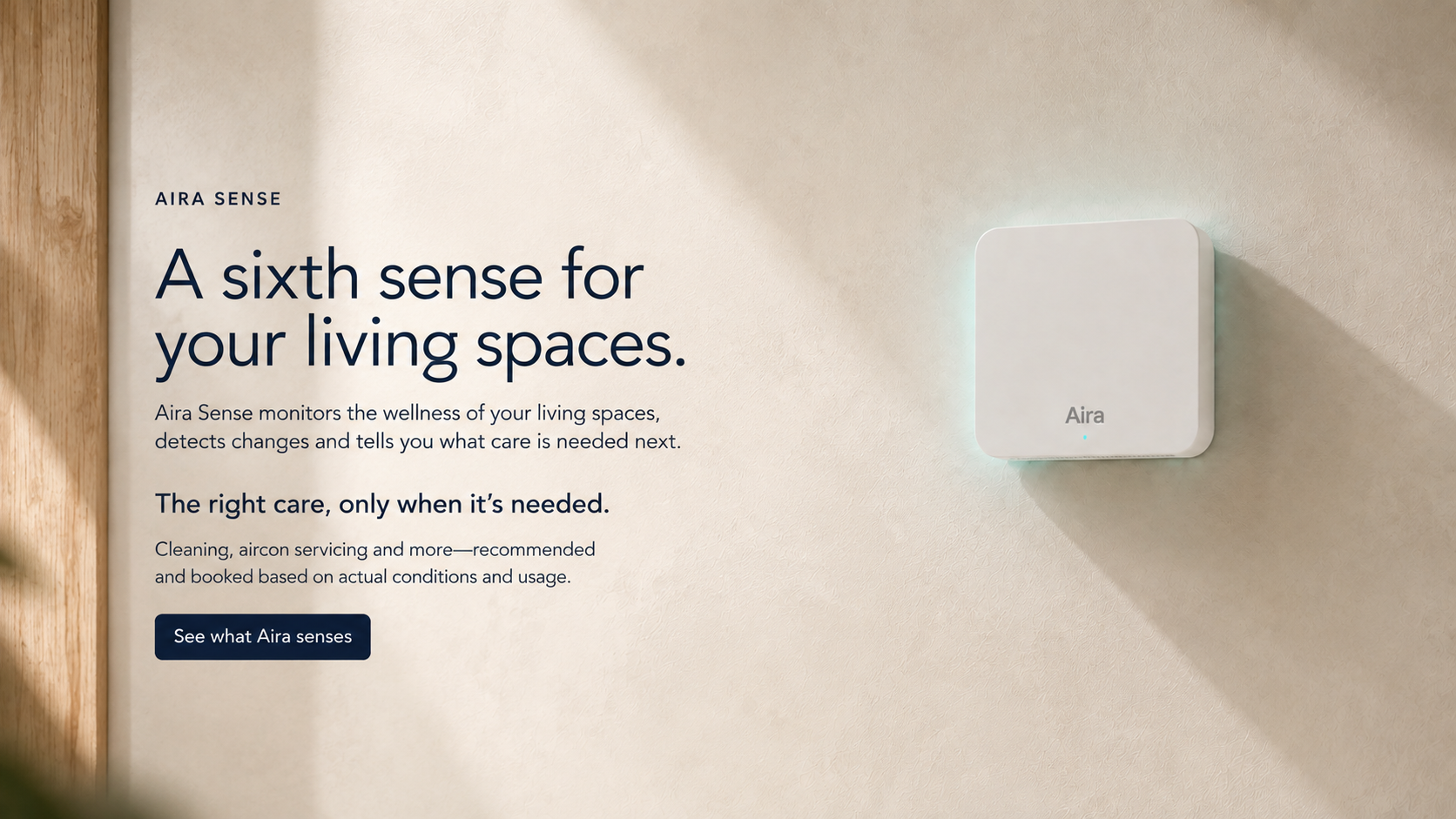
Quick Answer
Aira Sense is the indoor measurement layer of Pico X Health's three-part home wellness system. AMRI, the Aira Mould Risk Index, scores outdoor mould pressure across Singapore from humidity, rainfall, temperature and wind; the Aira Home Wellness Index at airahales.com/home-wellness scores your own household's risk — structural factors plus noise and UV exposure; and the Aira Sense unit measures humidity, temperature, CO2, TVOC and particulates live in the room. Both indices are AI-calibrated on 3,000 customer data points and Singapore environmental sensor data using our own proven algorithm, so alerts, service timing and post-remediation verification rest on measurement rather than assumption. From S$3.50 a month, free with Pico X Health services.
Based on: Field Data Verification · Pico X Health Research · Prevention & Protection
The Aira Sense loop: monitor, understand, act, verify
Remediation is normally a one-off event with no measurement on either side of it. Aira Sense turns it into a closed loop, so every action is triggered by a reading and judged by the reading that follows.
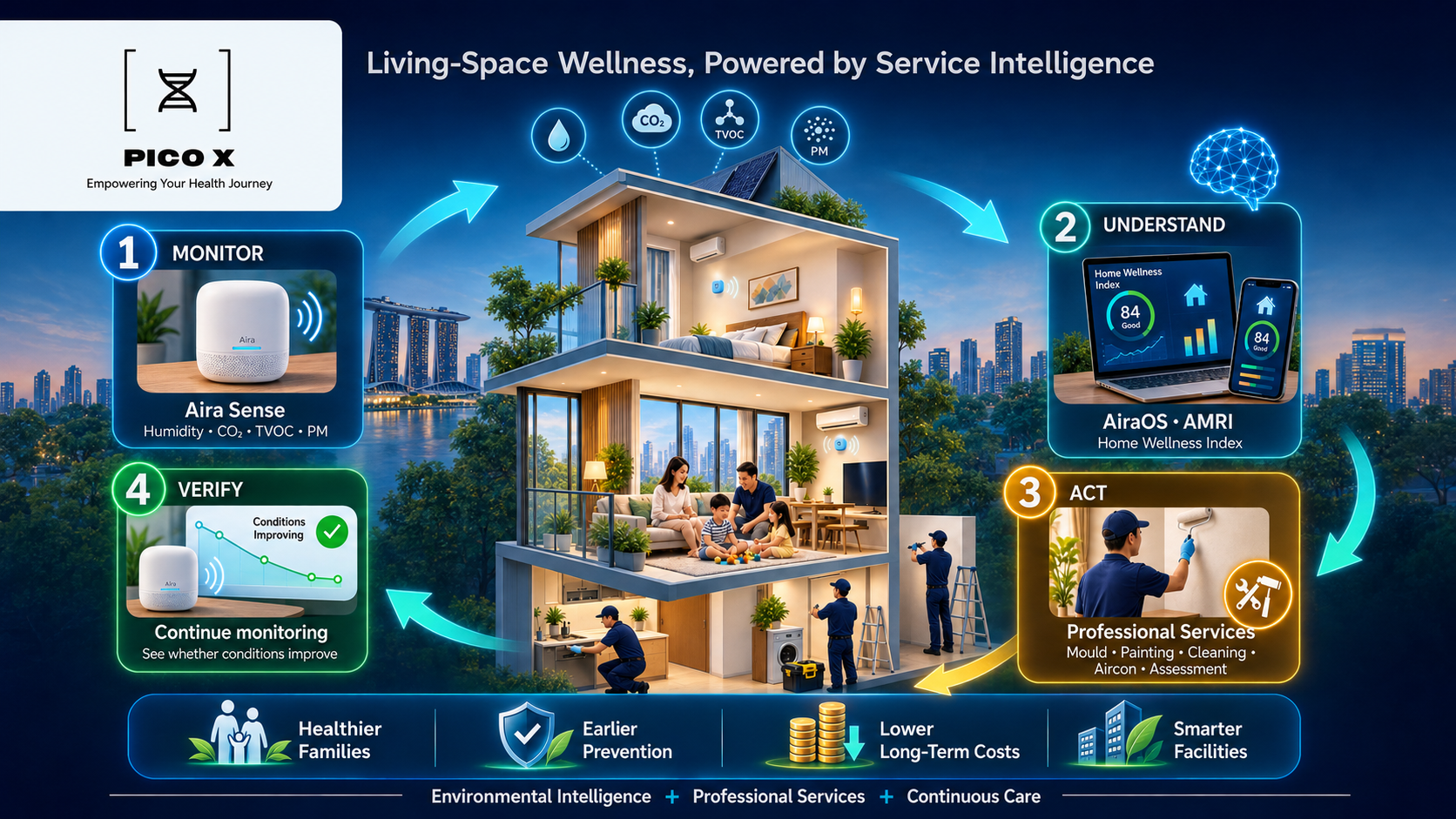
01 · Monitor
The Aira Sense unit reads humidity, temperature, CO2, TVOC and PM2.5/PM10 continuously — every room hour, not one spot check on inspection day.
02 · Understand
Readings become a single Aira Home Wellness Index score, plus plain-language alerts: too humid overnight, ventilation failing, aircon due, haze intrusion.
03 · Act
When an action needs a professional, the data says which one and when — aircon cleaning, dehumidification, condensation control, waterproofing or remediation.
04 · Verify
The same sensor proves the outcome. Danger-zone humidity hours should fall and stay down after works. If they don't, the source wasn't resolved and we return under warranty.
Outdoor + household + indoor = complete wellness data
Most monitoring reads one thing. We read three, and the value is in the overlap: AMRI tells you what Singapore's environment is doing to living spaces today, the Aira Home Wellness Index tells you how vulnerable your particular unit is to it — structure, noise and UV included, and Aira Sense tells you what is actually happening in your room right now.
| Layer | Index | What it tells you |
|---|---|---|
| Outdoor | AMRI — Aira Mould Risk Index | A daily 0-100 mould risk score for Singapore conditions, built from humidity, rainfall, temperature and wind. It answers the question that decides most living spaces' humidity: is today an hour to open the windows, or to keep them shut and run dry mode? |
| Household | Aira Home Wellness Index | The free assessment at airahales.com/home-wellness that profiles your unit — age, orientation, ventilation, past leaks and neighbour-unit patterns, plus noise and UV exposure — into a risk score, the structural weak spots, and the prevention priorities worth spending on first. |
| Indoor | Aira Sense — live room data | Humidity, temperature, CO2, TVOC and PM2.5/PM10, measured continuously in the room itself. This is the layer that turns the two indices from a forecast into a fact about your living space — and the only one that can prove a remediation worked. |
How the two indices are calibrated: AMRI and the Aira Home Wellness Index are AI-calibrated on 3,000 Pico X Health customer data points and Singapore environmental sensor data, tuned with our own proven algorithm rather than a generic humidity rule of thumb. The calibration is refined against real remediation outcomes — which living spaces recurred, which held, and what the readings looked like in each case.
AMRI (outdoor pressure) + Aira Home Wellness Index (household vulnerability) + Aira Sense (live room data) → complete wellness read → the right action → verified outcome. See the free AMRI mould alerts or check your Aira Home Wellness Index.
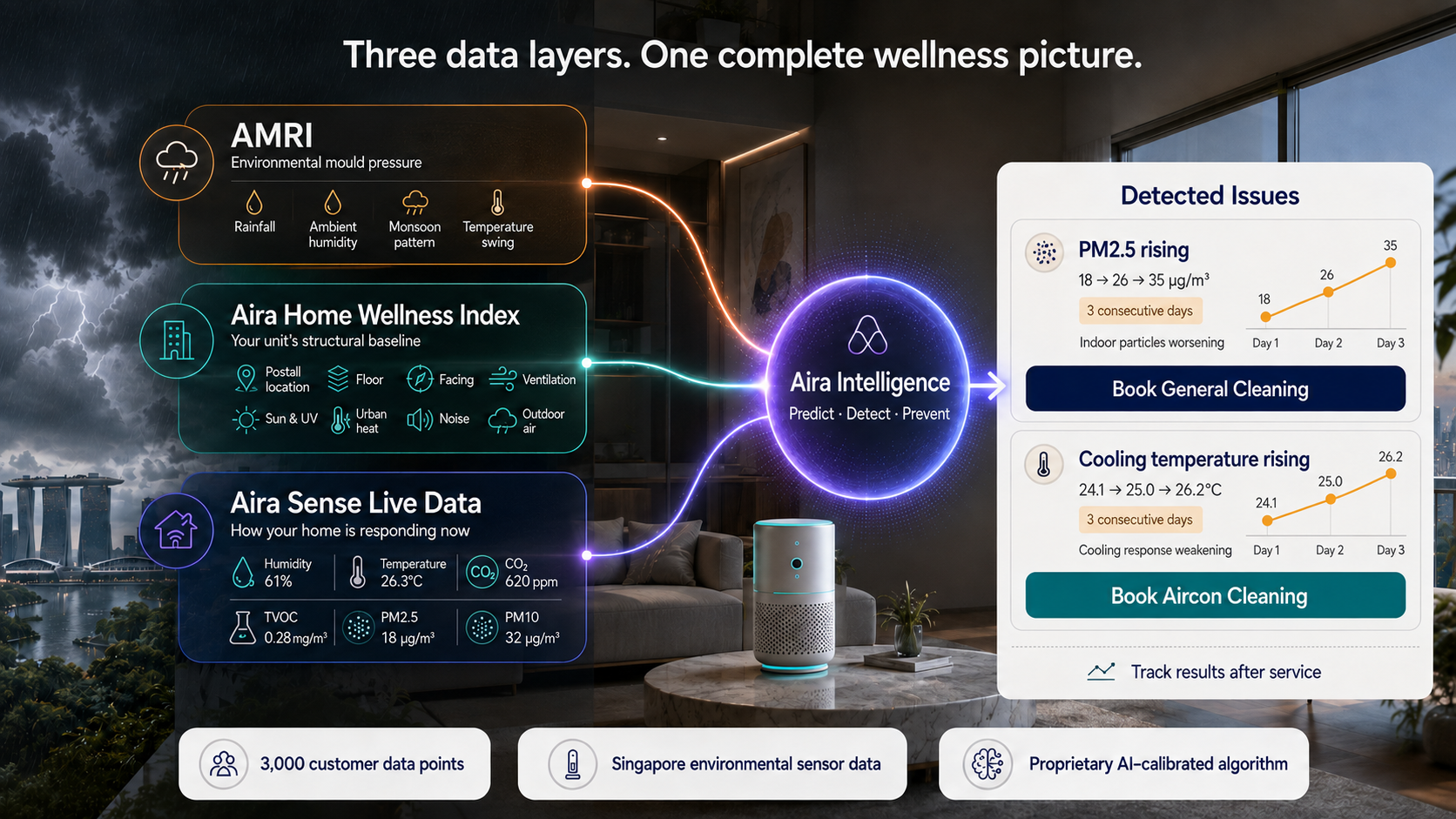
What goes in
- AMRI — environmental mould pressure: rainfall, ambient humidity, monsoon pattern, temperature swing.
- Aira Home Wellness Index — your unit's structural baseline: postal location, floor, facing, ventilation, sun and UV, urban heat, noise, outdoor air.
- Aira Sense live data — how your living space responds now: humidity, temperature, CO2, TVOC, PM2.5, PM10.
How a recommended service is produced
- Trend, not a spike: a reading must move in one direction over about three consecutive days before it counts.
- Context-weighted: the same humidity reading means different things on a shaded high floor and a west-facing low floor during monsoon.
- Mapped to one action: PM2.5 climbing 18 → 26 → 35 µg/m³ points to general cleaning; cooling drifting 24.1 → 25.0 → 26.2 °C points to aircon cleaning; sustained humidity and surface risk point to mould inspection or remediation.
- Verified after service: the same sensors track whether the reading returned to baseline.
What Aira Sense measures — and why each one matters in Singapore
| Sensor | What it reads | Why it matters here |
|---|---|---|
| Relative humidity | Mould growth risk and condensation risk | Sustained hours above roughly 70% RH is what feeds a colony. Aira Sense counts those hours instead of showing a single number. |
| Temperature | Dew point and cold-surface risk | Paired with humidity it predicts condensation on aircon ledges, bulkheads, window reveals and cold water pipes. |
| CO2 | Ventilation adequacy | Rising overnight CO2 in a closed bedroom means air is not exchanging — the same stagnation that lets moisture settle on surfaces. |
| TVOC | Chemical off-gassing | New furniture, fresh paint, cleaning products and a fouled aircon coil all show up here. Useful after renovation and in nurseries. |
| PM2.5 / PM10 | Particulates and haze | Tracks haze intrusion, cooking load and aircon filter condition, so filter changes happen on evidence rather than habit. |
Servicing on data, not on the calendar
A quarterly aircon contract cleans units that are still clean and misses the one that fouled early. Aira Sense reads the signature of a failing unit — humidity that stops dropping during cooling cycles, particulates rising with runtime, a TVOC lift from a wet coil — and books the service when the data says it is due.
The same logic applies to dehumidification, condensation control and re-coating. You spend on the interventions your living space is actually asking for, at the point where they still prevent damage instead of repairing it. See aircon mould servicing and anti-condensation solutions.
- Humidity: more than 6 hours a day above 70% RH for a week — dehumidification or ventilation review.
- Cooling anomaly: humidity no longer falling during aircon runtime — coil and drip pan service.
- CO2: sustained overnight build-up in a bedroom — ventilation or exhaust fan fix.
- Particulates: indoor PM tracking outdoor haze — filtration and seal review.
- Post-works drift: danger-zone hours creeping back after remediation — warranty callback.
How measured remediation compares
Most remediation — locally and internationally — ends at the surface treatment. The gap is not the chemistry; it is that nobody measures the living space before or after.
| Capability | DIY / cleaner | Typical SG remediator | Global pest & hygiene group | Pico X Health + Aira Sense |
|---|---|---|---|---|
| Continuous sensor monitoring | No | No | Yes | Yes |
| Outdoor environmental risk index (AMRI) | No | No | No | Yes |
| Household risk assessment incl. noise & UV (Aira Home Wellness Index) | No | No | No | Yes |
| AI-calibrated on real customer outcome data | No | No | No | Yes |
| Baseline reading taken before works | No | No | No | Yes |
| Post-works verification from the same sensor | No | No | No | Yes |
| Moisture source repair (waterproofing, condensation control) | No | No | Yes | Yes |
| Predictive, usage-based aircon servicing | No | No | No | Yes |
| Antimicrobial coating system with warranty | No | Yes | Yes | Yes |
| Published in-house research behind the protocol | No | No | No | Yes |
| Non-toxic, safe around babies and pets | No | No | No | Yes |

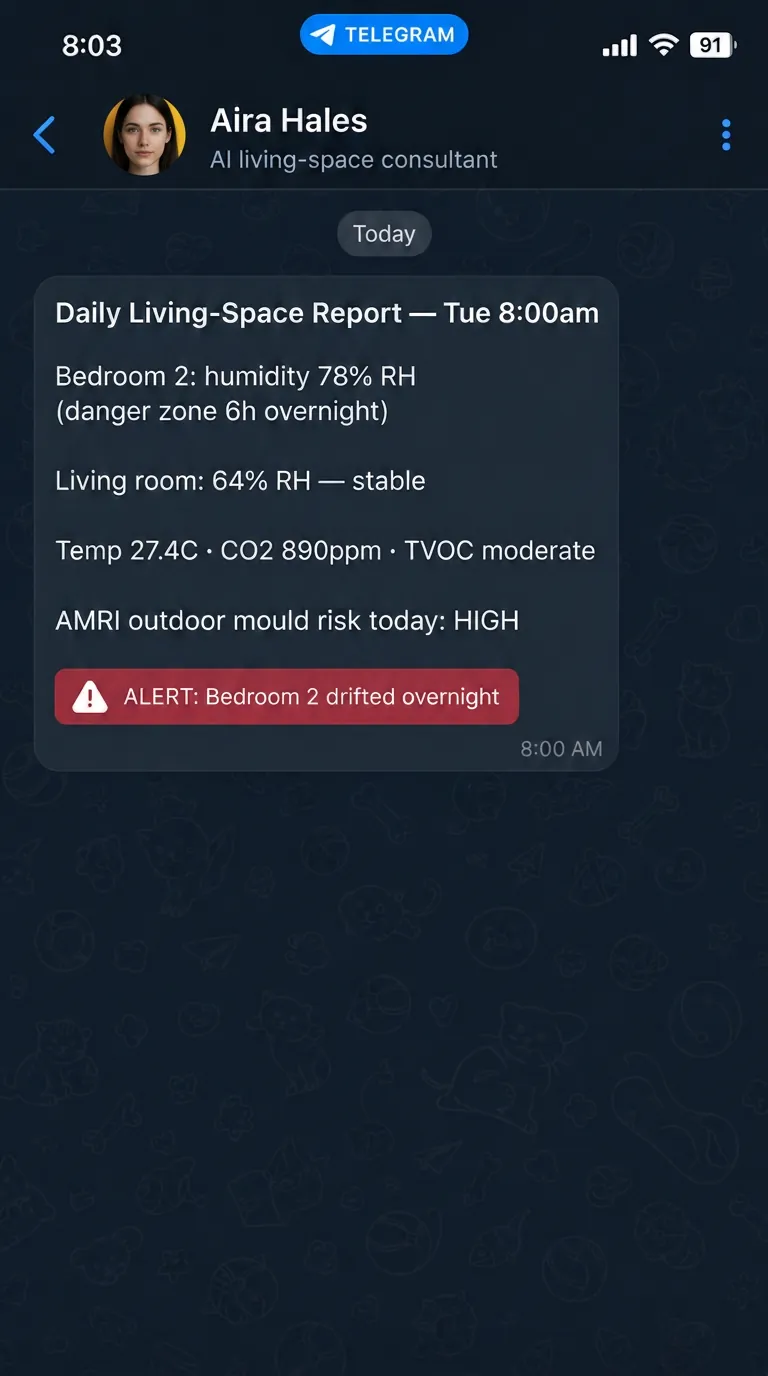
Aira Hales flags alerts and suggests what to do — on Telegram
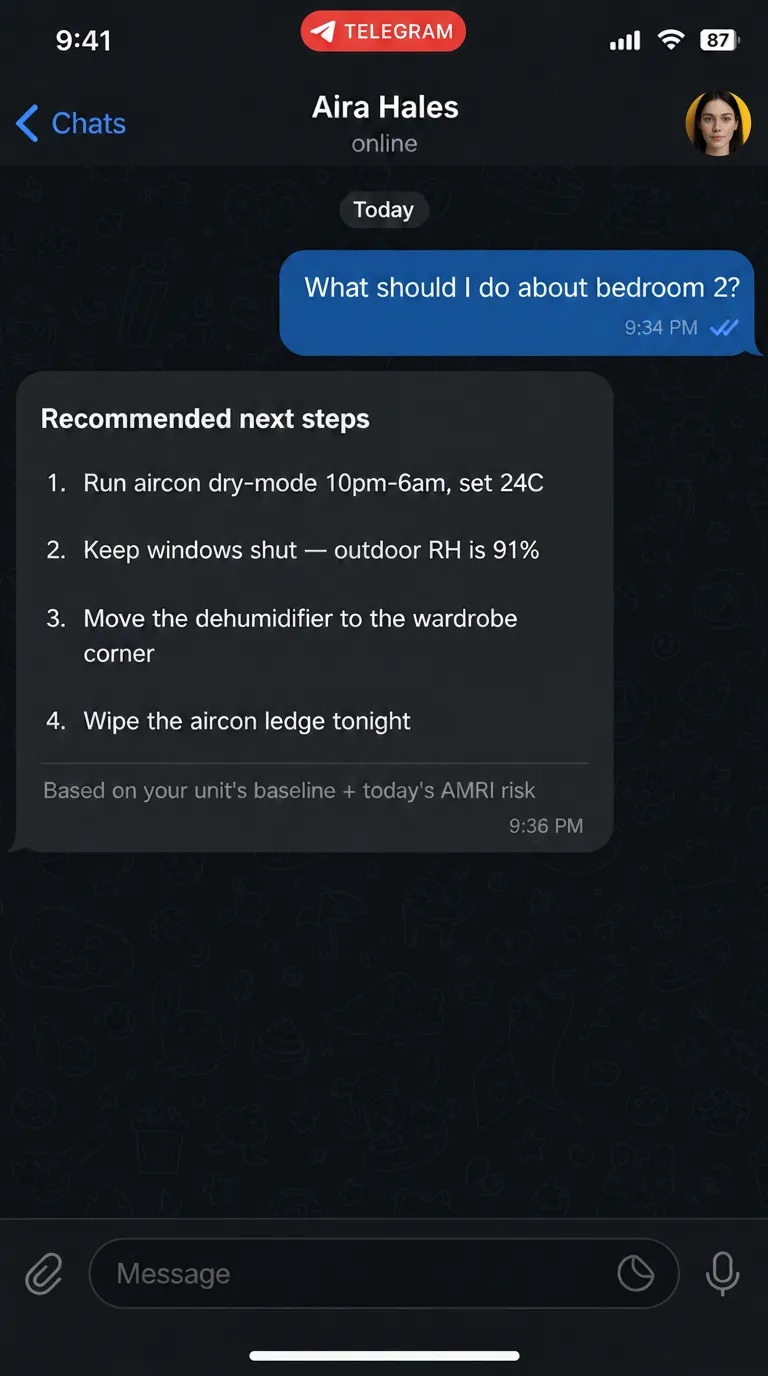
Aira Sense is the measurement. Aira Hales is our AI living-space consultant on Telegram, and it is where the data reaches you: a daily report that flags what changed, explains why, and suggests the next step based on your data. Free and included. Learn about Aira Hales.
- A daily report lands on Telegram. Humidity, temperature, CO2, TVOC and particulates for your living space, read against today's AMRI outdoor mould risk.
- Aira Hales flags alerts and suggests what to do. Open the windows for 20 minutes this afternoon, run aircon dry-mode tonight, wipe the aircon ledge, move the dehumidifier into the wardrobe corner — chosen from your own data and the outdoor index.
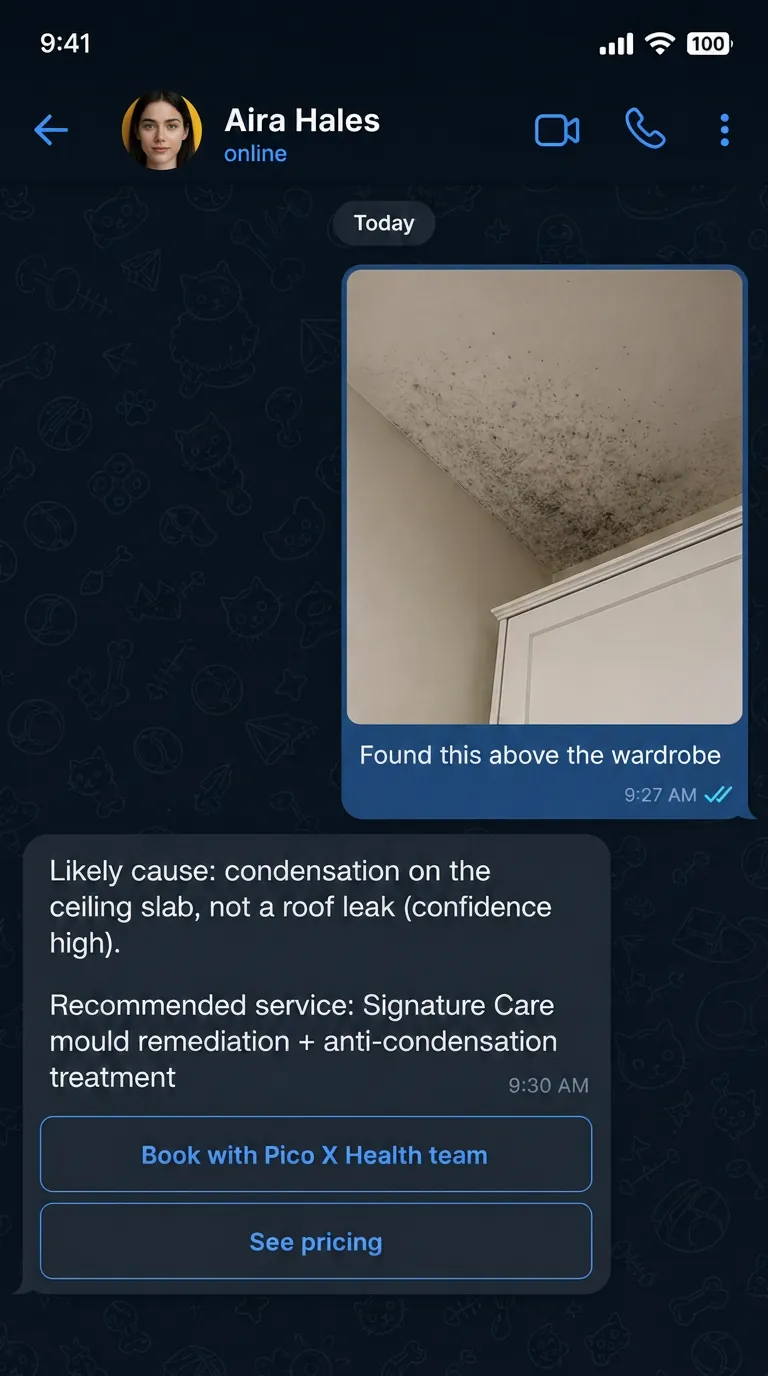
- Ask anything, send a photo. Damp patch, black spotting, a crack or a sweating ledge — Aira Hales reads the image and tells you what you are looking at and whether it needs a professional.
- Our team executes the recommended step. When the data says the fix needs hands, Aira Hales routes the recommended service to the Pico X Health team — then verifies the outcome on the following days' reports.
Chat free on Telegram (@Airahalesbot) or start with our free mould & humidity alerts.
Aira Sense questions, answered
What is Aira Sense?
Aira Sense is the indoor measurement layer of Pico X Health's three-part home wellness system. The unit continuously measures humidity, temperature, CO2, TVOC and particulate matter in your room, and pairs those live readings with two AI-calibrated indices: AMRI, the Aira Mould Risk Index for outdoor conditions across Singapore, and the Aira Home Wellness Index, the household assessment at airahales.com/home-wellness. Together they warn you before conditions turn mould-friendly, tell our team when a service such as aircon cleaning or dehumidification is actually needed, and verify the outcome afterwards. From S$3.50 a month, free with Pico X Health services.
What is AMRI and how does it differ from the Aira Home Wellness Index?
AMRI — the Aira Mould Risk Index — is the outdoor layer. It turns Singapore environmental data (humidity, rainfall, temperature and wind) into a daily 0–100 mould risk score with a clear action, such as whether today is a good hour to open the windows or keep them shut. The Aira Home Wellness Index is the household layer: the free assessment at airahales.com/home-wellness that profiles your specific unit — its age, orientation, ventilation, past leaks, structural weak spots, noise and UV exposure — and ranks your prevention priorities. AMRI tells you what the environment is doing to living spaces like yours today; the Aira Home Wellness Index tells you how vulnerable your living space is to it; Aira Sense measures what is actually happening inside your room.
How are the two indices calibrated?
Both AMRI and the Aira Home Wellness Index are AI-calibrated against 3,000 Pico X Health customer data points and Singapore environmental sensor data, using our own algorithm rather than a generic humidity rule of thumb. The calibration is refined against real remediation outcomes — which living spaces recurred, which held, and what the readings looked like in each case — so the scores reflect what actually predicts mould in Singapore building stock.
Why does outdoor data matter when the sensor sits indoors?
Because most Singapore living spaces breathe. Indoor humidity is largely a function of what is happening outside and how you ventilate against it: opening windows during a wet monsoon hour actively imports moisture, while the same action on a dry, breezy afternoon dries the living space out. Reading indoor conditions alone tells you that a room is humid; reading them against AMRI tells you whether the cause is outside pressure, your ventilation behaviour, or a defect such as a leak or cold bridge — and therefore what to do about it.
Do I need Aira Sense if I already use AMRI alerts and the Home Wellness check?
AMRI and the Aira Home Wellness Index are free and predictive — they tell you the risk. Aira Sense is the confirmation: it measures your actual room, so guidance becomes specific to your bedroom, nursery or clinic instead of general to Singapore, and it is the only one of the three that can prove a remediation worked. If you have never had a mould problem, the two free layers may be enough; if you have had one, or are paying for works, the measurement layer is what closes the loop.
How does a sensor prevent mould?
Mould needs sustained surface moisture, not a single humid afternoon. Aira Sense watches relative humidity over time and flags the hours your rooms spend above the growth threshold — typically 70% RH — long before a stain appears. Read against the day's AMRI score you get a specific action for the conditions of that day, such as running aircon dry mode, opening windows during a dry afternoon, or keeping them shut during a monsoon hour when outdoor air is wetter than indoor.
How does Aira Sense verify that mould remediation worked?
We take a sensor baseline before works begin and keep the sensor in place afterwards. The reading trend after remediation is the proof: humidity hours in the danger zone should fall and stay down. If they do not, the moisture source was not fully resolved and we come back under warranty. Most remediation companies leave the job with no measurement at all, so nobody can tell whether the living space actually improved.
What exactly does it measure?
Relative humidity and temperature (mould risk and condensation risk), CO2 (ventilation adequacy and stuffiness), TVOC (chemical off-gassing from furniture, paint or cleaning products) and PM2.5/PM10 particulates (haze, cooking and aircon filter condition). Together these describe both the mould risk and the general air quality of the room.
How is this different from a cheap hygrometer or a smart air monitor?
A hygrometer shows a number. A consumer air monitor shows a graph. Aira Sense is connected to a remediation team — the readings trigger a specific recommended action, and when the action needs a professional, the service is booked and later verified against the same sensor data. It is the measurement layer of a service, not a standalone gadget.
What is the Aira Home Wellness Index?
The Aira Home Wellness Index is the free household assessment at airahales.com/home-wellness. It profiles your specific unit — Singapore building stock, weather zone, orientation, ventilation, past leaks, neighbour-unit patterns, noise levels and UV exposure — and returns a unit-level risk score, the structural weak spots most likely to grow mould, and what to fix first versus what can wait. It is AI-calibrated on 3,000 customer data points with our own algorithm. Aira Sense then measures the same living space live, so the assessment stops being a prediction and becomes a running record of how your living space is actually doing.
How does predictive aircon maintenance work?
Aircon fouling shows up in the data before it shows up in your nose. When cooling cycles start coinciding with rising particulates, humidity that no longer drops during cooling, or a TVOC rise, that pattern means the coil and drip pan need attention. We service on that signal instead of on a fixed calendar, so you are neither cleaning a clean unit nor waiting until it smells.
How much does Aira Sense cost?
From S$3.50 per month. It is included free for the duration of Pico X Health service engagements such as mould remediation, anti-condensation coating or aircon servicing, so existing customers get the monitoring layer at no extra cost.
Where should I place the sensor?
In the room that matters most to you and, if you only have one unit, the room with a history of problems — usually a bedroom, nursery or the room adjacent to a bathroom or aircon ledge. Place it at roughly chest height, away from direct aircon airflow, windows and heat sources, so it reads room conditions rather than a draft.
Do I need wifi?
Yes, a normal 2.4GHz living space wifi network. The sensor uploads readings continuously so alerts, trends and your AMRI-adjusted guidance stay current even when you are away from living space.
What happens to my data?
Readings are environmental only — humidity, temperature, CO2, TVOC and particulates. There is no camera, no microphone, and no recording of anything said or done in the living space. Data is used to generate your alerts, to sharpen your Aira Home Wellness Index and AMRI guidance, and, where you engage us, the before-and-after verification for your service.
Does Aira Sense replace a professional mould inspection?
No. A sensor tells you the conditions of the air; an inspection tells you where the water is coming from. Aira Sense catches the risk early and confirms outcomes afterwards, but a thermal and moisture inspection is still what locates a leak, a cold bridge or a failing waterproof membrane.
How is Aira Sense related to Aira Hales on Telegram?
Aira Hales is the conversational layer — the free Telegram companion that answers questions, reads photos and pushes weather-based mould guidance. Aira Sense is the measurement layer that gives Aira Hales your actual room data, so guidance becomes specific to your living space instead of general to Singapore.
Can Aira Sense be used in offices, clinics and facilities?
Yes. Multi-unit deployments are used in offices, clinics, childcare centres and F&B premises where indoor air quality is both a compliance and a reputation issue. The same loop applies: baseline, alerting, service triggered on data, and a documented improvement trend you can show to a landlord, an auditor or a tenant.
Will it tell me if my living space is safe for a baby?
It will tell you whether the conditions in the nursery are within the range associated with healthy sleep and low mould risk — humidity, CO2 build-up overnight, and particulate levels. It is not a medical device and does not diagnose health conditions, but it removes the guesswork from questions like whether the room is too humid or too stuffy.
Related reading
Start measuring your living space
Tell us the room you are worried about. We will advise whether monitoring alone is enough, or whether the readings should be paired with a source fix first.